
END OF LIFE NOTICE – Storm, Xpress & GP241xx series
As of April, 23rd, 2018, Byte Paradigm announces the end-of-life of all models of SPI Storm, LOG Storm, Xpress and GP-241xx series.
Our stocks are exhausted.
-
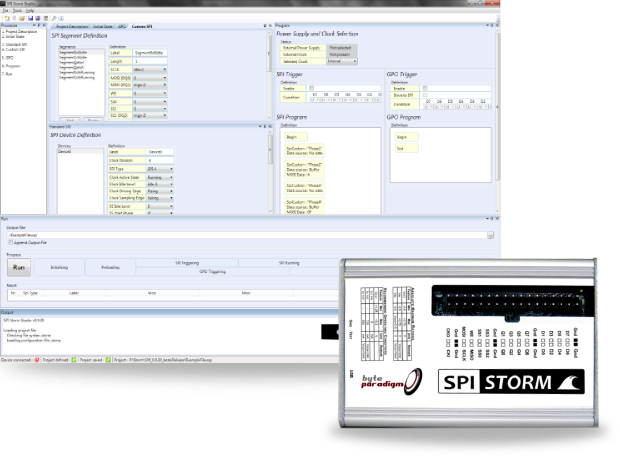
- Up to 100 MHz operation
- Serial Peripheral Interface (SPI)
- Dual-SPI, Quad-SPI
- Bi-directional and open-drain I/O
- 8-bit GPO / digital pattern generator
- Up to 32 MB total memory
+ Custom protocol engine.
Check Advanced Information →… the highest effective data throughput we have seen on any USB SPI adapter…
— H. Storm, Fingerprint Cards
How does it work?
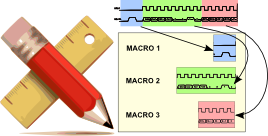
1. Set up serial protocol
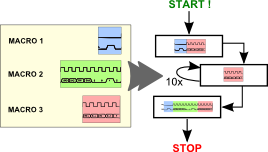
2. Build up sequences
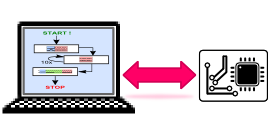
3. Run & retrieve data
Define how SPI Storm should access your slave and build up a library of commands.
Select standard protocol like SPI or Quad-SPI. Need something more exotic? The protocol definition engine lets you define when the device should read and/or write, keep HI-Z, pause – and many more options…
Read more →
Select standard protocol like SPI or Quad-SPI. Need something more exotic? The protocol definition engine lets you define when the device should read and/or write, keep HI-Z, pause – and many more options…
Read more →
Build up sequences of accesses from your library.
A large program buffer lets you pile up commands in order to get minimal or pre-defined latency between accesses.
Read more →
A large program buffer lets you pile up commands in order to get minimal or pre-defined latency between accesses.
Read more →
Execute your sequences from SPI Storm Studio and access your slave with your USB 2.0 SPI Storm device.
Retrieve data read from your slave(s) and save them on your PC.
Read more →
Retrieve data read from your slave(s) and save them on your PC.
Read more →
Technical resources
Download
-
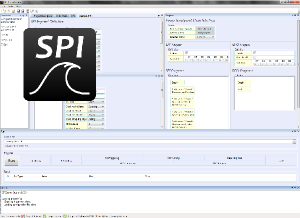
SPI Storm Studio version 1.1.29
- SPI Storm Studio software installation guide (PDF)
- SPI Storm Studio release notes (PDF)
- SPI Storm Studio User’s Guide
- Example of SPI Storm Studio C/C++ program with DLL
- Example of SPI Storm Studio project file (.ssp) for custom protocol and MIPI RFFE protocol
Documentation
- Introducing SPI Storm – White paper
- SPI Storm data sheet
- SPI Storm Studio Software Installation Guide
- SPI Storm Studio Getting Started Guide
- SPI Storm Studio User’s Guide
- SPI Storm Studio C library User’s Guide
SPI Storm – Serial Protocol Host Adapter
October 29, 2012